
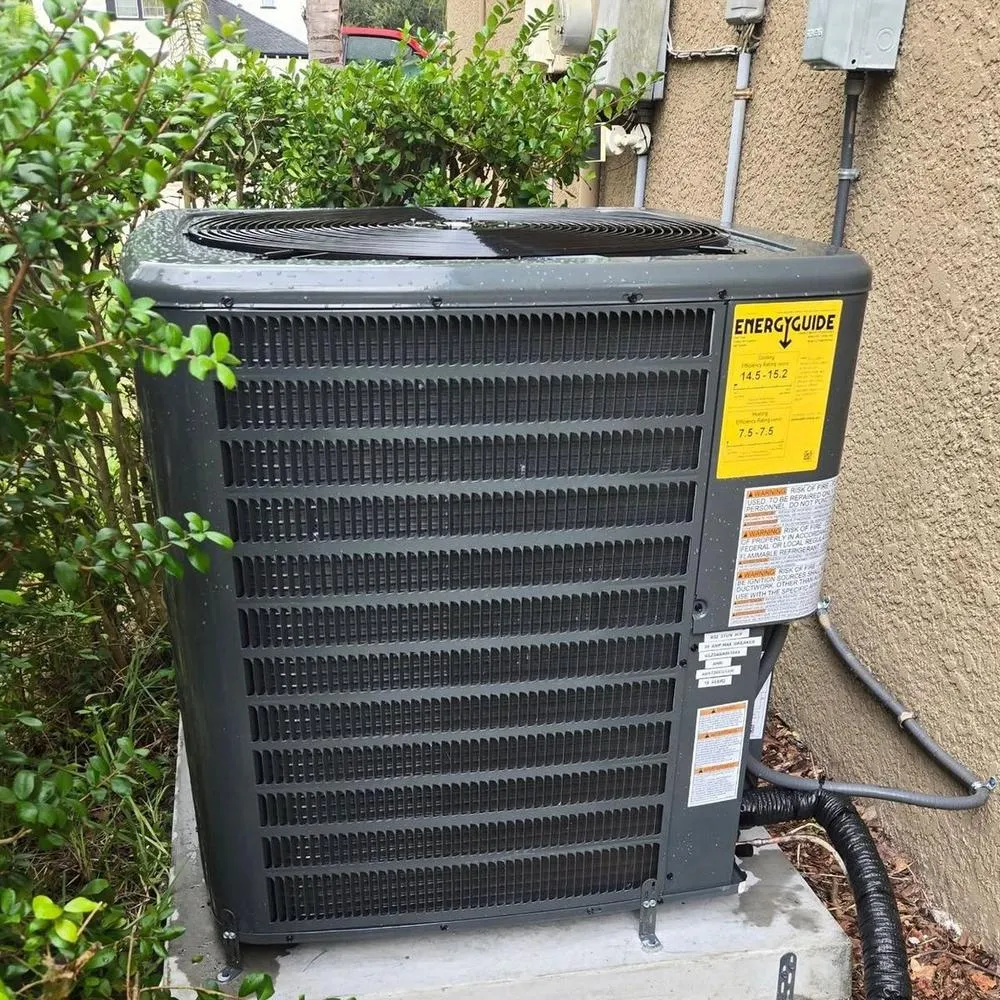
The compressor is going. Or the coil is leaking. Either way, there's a quote on your kitchen table with a comma in it, and a decision that can't wait for a cooler day: do you put real money into this system, or put that money toward a new one? It's the most expensive question in homeownership that nobody teaches you how to answer.
Techs have a rule of thumb for exactly this moment. It's called the $5,000 rule — some folks call it the 5000 AC rule — and it's not a sales trick. It's one multiplication that tells you which way the math leans, repair or replace. We're putting it right here so you can run it yourself, on any quote, from any company — including ours. If you landed here by searching what is the 5000 rule, you're in the right place.
The rule, in one line
Take the repair quote. Multiply it by your system's age in years. If the answer is over $5,000, replacement usually wins. Under $5,000, the repair usually wins. That's the whole rule. Here it is on real numbers:
Why the math works
Efficiency fades with age
A system loses cooling power every year it runs, and drinks more electricity doing it. An older unit costs you more every month even when it's "working" — the rule quietly prices that in.
Repairs cluster
Parts age together. The repair you approve this summer is rarely the last one on an older system — it's usually the first of a run. Age times dollars is a rough way of counting how many more of those are coming.
Old parts get pricier
As refrigerant generations change — R-22 yesterday, R-410A today — parts and refrigerant for older systems get scarcer, slower to source, and more expensive. The same repair costs more at year 14 than it did at year 9.
A new system resets the clock
A new installation starts the warranty over — 10-year parts coverage — with modern efficiency and a system sized for your home today. When the rule says replace, that's what the replacement money is actually buying.
“The rule isn’t ‘always replace.’ It’s ‘do the math before you write the check.’ If the numbers say fix it, I’ll fix it — I’ve talked more people OUT of new systems than into them.”
When to break the rule
A rule of thumb isn't a law. Repair anyway when:
- The repair is cheap and the system is otherwise healthy. A small fix on a well-kept unit that cools the house fine — condition beats arithmetic.
- The unit is still under parts warranty. If the part is covered, your real cost is labor. Run the math on what you'd actually pay, not the sticker quote.
- You're selling the house within a year. A working repair keeps the sale simple. A replacement is an investment you won't be there to collect on.
- It's a wear part, not a death sentence. Capacitors and contactors wear out on good systems too. A compressor or a coil going is the system itself failing — different problem, different math.
The Tampa factor
Here's the part the national articles miss: Tampa systems live harder than almost anywhere in the country. Our cooling season runs most of the year, the humidity never clocks out, and salt air near the bay works on outdoor units from the outside in. A 12-year-old system in Tampa has far more run-hours on it than a 12-year-old system up north, where it gets winters off.
So run the rule honestly down here: in Tampa, age counts harder. If your number lands anywhere near $5,000, it leans replace more than the raw math suggests — and if it's clearly under, fix it with confidence and keep the system maintained so it stays under.
Questions & Answers
What is the $5,000 rule for AC?
Multiply the repair quote by your system's age in years. If the result is over $5,000, replacing the system usually makes more sense than repairing it. Under $5,000, the repair usually wins. It's a rule of thumb, not a law — warranty status and the kind of repair matter too.
Is the $5,000 rule the same as the $5,000 AC rule?
Yes — same rule, same math. Some people call it the 5000 rule or the AC replacement rule. However you hear it, it's repair cost times system age, compared against $5,000.
What if my system keeps breaking but each repair is under the number?
Add the repairs up. Two $800 repairs in one summer on a 10-year-old system is $1,600 into a unit that's still aging — and the rule uses the NEXT repair quote, not the last one. If you're calling every season, the math has already answered.
Does the $5,000 rule apply to heat pumps?
Yes. Heat pumps age the same way and Tampa heat pumps work year-round — cooling in summer, heating in winter — so their years are hard years. The same repair-times-age math applies.
How much does a new AC system cost in Tampa?
Most full replacements land in the low-to-mid thousands up to the low five figures depending on size, efficiency, and ductwork condition. We quote exact numbers in writing after measuring the home — free same-day estimates, and right now new split system installations come with $500 off and a free UV light.
Math pointing both ways?
We'll run the numbers with you — honestly. Free same-day estimates with the exact quote in writing, and right now $500 off new split system installations.
Call (813) 770-2722 AC Installation