
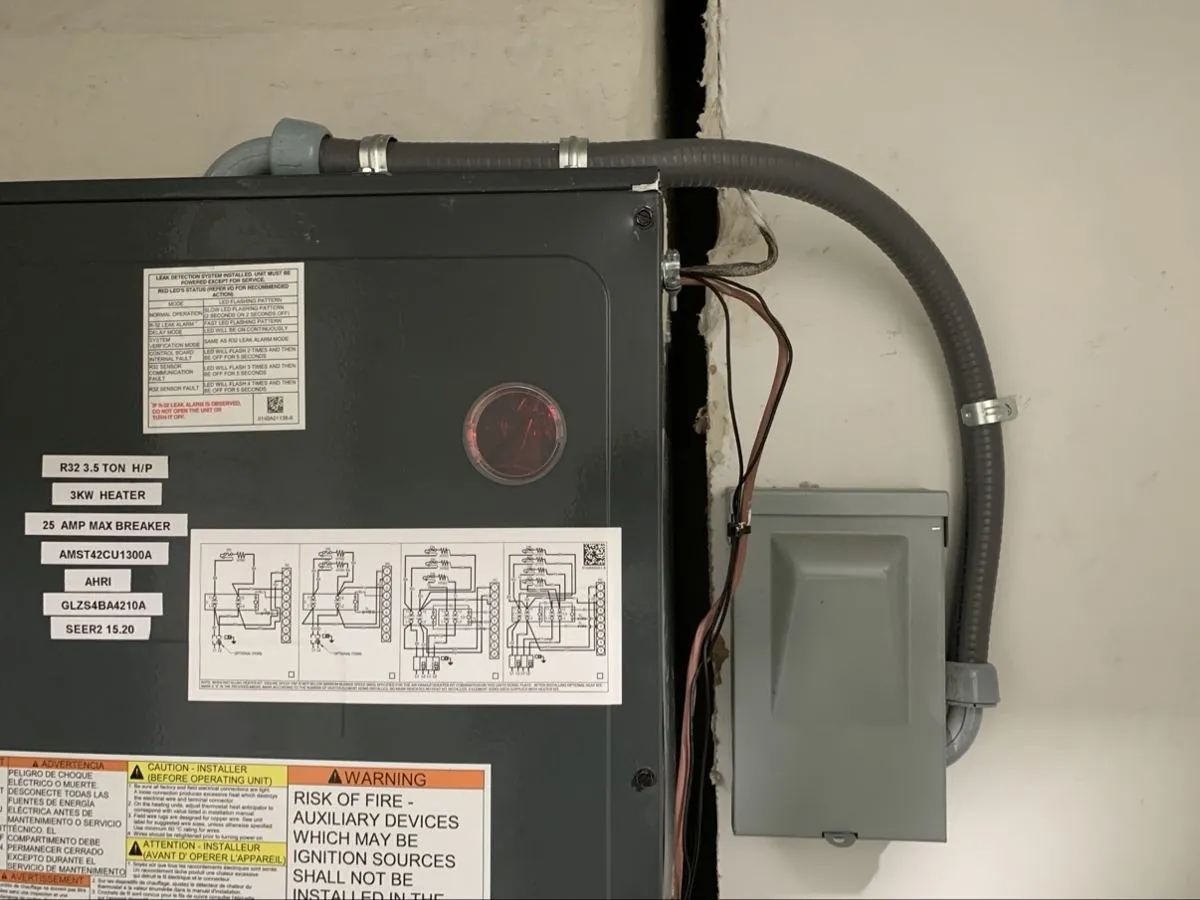
A breaker trips for one reason: too much current on the circuit. It’s a safety device, and when it trips on your AC it’s protecting your wiring, your equipment, and your house. One trip after a lightning storm can be a surge and nothing more. But a breaker that trips again — especially the moment the AC tries to start — means a real fault is pulling excess current: a shorted or grounded compressor or motor, a weak breaker, a dirty coil driving amps up, or a loose connection heating up. The pattern tells the story, and the worst thing you can do is keep resetting it until something gives.
The real causes
“A breaker that trips twice is telling you something. The third reset isn’t troubleshooting — it’s gambling with your compressor and your wiring. Leave it off and let someone with a meter find the fault.”
What to do right now
Reset it exactly once. If it holds and the AC runs normally, watch it: a single trip after a storm can be a surge and nothing more. If it trips again, leave it OFF. Check the filter (a clogged filter strains the whole system) and look at the outdoor unit — is the coil visibly caked with debris? Don’t open the panel or the disconnect yourself; if you smell burning or see scorch marks, keep the power off and call. A tech will measure amp draw, test the breaker, and find the fault instead of guessing.
What to never do
Never hold a breaker in the ON position, tape it, or swap in a bigger breaker to “stop the tripping.” The breaker size protects the wire — a bigger breaker lets the wire overheat before anything trips, and that’s how electrical fires start. Don’t bypass the disconnect or the breaker either. And don’t keep resetting it every hour to get through the night: each trip is a surge of current through a fault that may be damaging the compressor.
Why it matters in Tampa
Lightning is the Tampa twist. Our afternoon storms throw surges that weaken breakers and fry control boards, and salt air corrodes connections faster than inland. That’s why a single storm-night trip often means nothing — but a pattern of trips after storms means surge damage worth checking. A whole-home surge protector is cheap insurance for everything on the panel, not just the AC.
Questions & Answers
Why does my AC keep tripping the breaker?
Something on the circuit is drawing too much current: a shorted or grounded compressor or motor, a weak breaker, a dirty coil pushing amp draw up, or a loose connection. A technician measures amp draw and tests the breaker to find which one.
Can I just reset the breaker and keep going?
Once is fine — a single trip can be a storm surge. If it trips again, leave it off. Repeated resets push surge current through a fault and can damage the compressor or wiring.
Is it the breaker or the AC?
Both are possible, and a meter settles it fast: the tech checks the breaker under load and the system’s amp draw against its rating plate. Breakers do wear out, so don’t assume the AC is at fault until it’s tested.
Can a dirty filter trip a breaker?
Indirectly. Restricted airflow strains the system and can freeze the coil or push the compressor harder, raising amp draw. It’s not the most common cause, but a clogged filter is always worth checking first because it’s free.
How much does it cost to fix a tripping AC breaker?
It depends on the cause: a breaker swap is a modest repair, a coil cleaning is routine, and a shorted compressor is a major repair. We diagnose it and quote you a flat price before any work starts — call (813) 770-2722.
Still tripped again?
If the breaker tripped more than once, leave it off and let us find the fault with a meter — not another reset. 24/7 service across Tampa Bay.
Call (813) 770-2722 AC Repair