
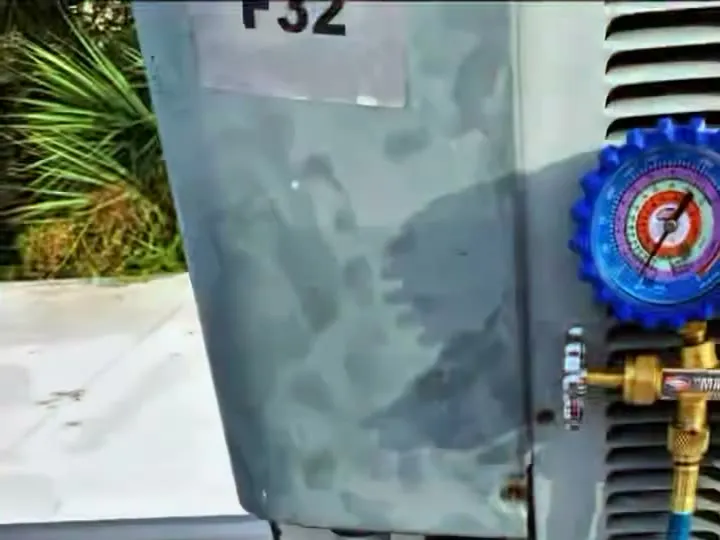
Your air conditioner doesn’t burn refrigerant the way a car burns gas. It’s a sealed loop — the same charge circulates over and over, year after year. So when a tech hooks up gauges and finds the system low, that means one thing: some of it got out. There’s a leak, somewhere.
Then why do so many systems get “topped off”?
Because topping off is fast, and on a hot day it works — for a while. The system cools again, everybody’s happy, and the leak is still there, quietly letting the new gas out. A slow leak might take months to show up again. A fast one takes weeks. Either way, you paid for refrigerant you no longer have, and the next visit starts the same conversation.
The signs your system is running low
- Air that isn’t as cold as it used to be, even though the system runs and runs.
- Long run times and higher electric bills — the system works harder to do less.
- Ice on the copper lines outside, or on the indoor coil.
- A faint hissing or bubbling sound near the indoor unit or the outdoor lines.
- Water around the indoor unit after ice melts off the coil.
Any one of these is worth a check. Ice especially — turn the system off and call before it gets worse, because a frozen coil can flood a drain pan and soak a ceiling.
Why a top-off costs more than a repair
Refrigerant is the most expensive thing we put in a system, and the price only goes one direction — especially R-22, the old Freon, which hasn’t been made in years and gets scarcer and pricier every summer. Paying to refill a leaking system twice is usually more than finding and fixing the leak once.
There’s a second problem with R-410A, which is what most Tampa systems run on. It’s a blend of two refrigerants, and when a blend leaks, the mix left behind isn’t the mix the factory put in. Topping it off doesn’t restore the original blend, so the system can run a little off even with a “full” charge. The right fix is to repair the leak, pull a vacuum, and weigh in the factory charge. No guessing. New systems run on R-32 or R-454B instead — same leak rule applies, and the charge still has to be weighed in. More on the new refrigerants here.
And running low is hard on the compressor — the most expensive part in the whole system. Low charge means poor cooling back to the compressor, which means heat, which means a shorter life. A leak you ignore can turn a small repair into a new system.
How we find the leak
Finding a leak is detective work, and guessing isn’t part of it. Here’s how it goes:
- Electronic detector — a sniffer that picks up refrigerant in the air around joints and coils.
- UV dye — dye goes in with the charge and shows up under a UV light exactly where it’s escaping.
- Nitrogen pressure test — the system gets isolated, pressurized with nitrogen, and watched. If the pressure drops, there’s a leak, and the hiss or the bubbles say where.
- Soap bubbles on a suspect joint — old-school, and still the fastest confirmation on a fitting.
The usual suspects: the indoor evaporator coil (the number-one leak spot in Florida — the coil sits in a damp, warm airstream its whole life), the outdoor coil, brazed and flare joints, service valves, and any place the copper line set rubs against framing.
What the fix looks like — and when replacement wins
Small leaks get small fixes: a valve core, a flare fitting, a brazed joint. A leaking coil usually means a new coil. A damaged line set means a section of new copper. After any repair, the system gets evacuated — a deep vacuum that boils out moisture and air — and the charge gets weighed in to the factory spec. That’s the part that makes it cool right and stay right.
Sometimes the honest answer is a new system instead: an old unit, a big coil leak, and R-22 still in the lines is the classic case. That’s exactly what the $5,000 rule is for — it keeps the repair-or-replace math honest. Read it before you approve a big repair.
One more thing worth knowing: handling refrigerant legally requires EPA certification. The DIY cans at the auto parts store are for cars, not houses — and venting refrigerant on purpose is illegal. If someone offers to “just shoot some gas in it” with no leak check, that’s the visit that costs you twice.
“If your system is low, it has a leak. Gas doesn’t just disappear. I don’t care who told you it ‘just needs a little gas.’ Find the leak, fix the leak, then charge it right. Topping it off is renting cold air.”
Questions & Answers
Can I just top off my AC every summer and skip the repair?
You can, but you’ll pay for the same refrigerant over and over, and the leak usually gets worse while you wait. A slow leak that costs a little to find now can become a dead compressor later. One leak check and one repair is cheaper than a summer of top-offs.
How much does a refrigerant leak repair cost?
It depends on where the leak is. A valve core or a fitting is the small end; a coil replacement is the big end. That’s why the estimate is free — nobody can price a leak honestly without finding it first.
Is leaking refrigerant dangerous in my house?
In the amounts a home system holds, it isn’t poisonous — but it can displace oxygen in a small enclosed space, and liquid refrigerant can burn skin on contact. The bigger risk is to the system: running low overheats the compressor. If you hear hissing or see ice, turn the system off and call.
Does the $75 tune-up check refrigerant?
Yes. Checking refrigerant pressures is part of the tune-up’s 9-point health check — that’s how a slow leak gets caught before it costs you a compressor. The tune-up runs through November 30.
Think Your System Has a Leak? Free Same-Day Estimates.
We’ll find the leak, fix it, and weigh the charge back in right — call (813) 770-2722. $500 off a new system, with a free UV light, is running now.
Call (813) 770-2722 AC Repair AC Tune-Up Maintenance Plans