
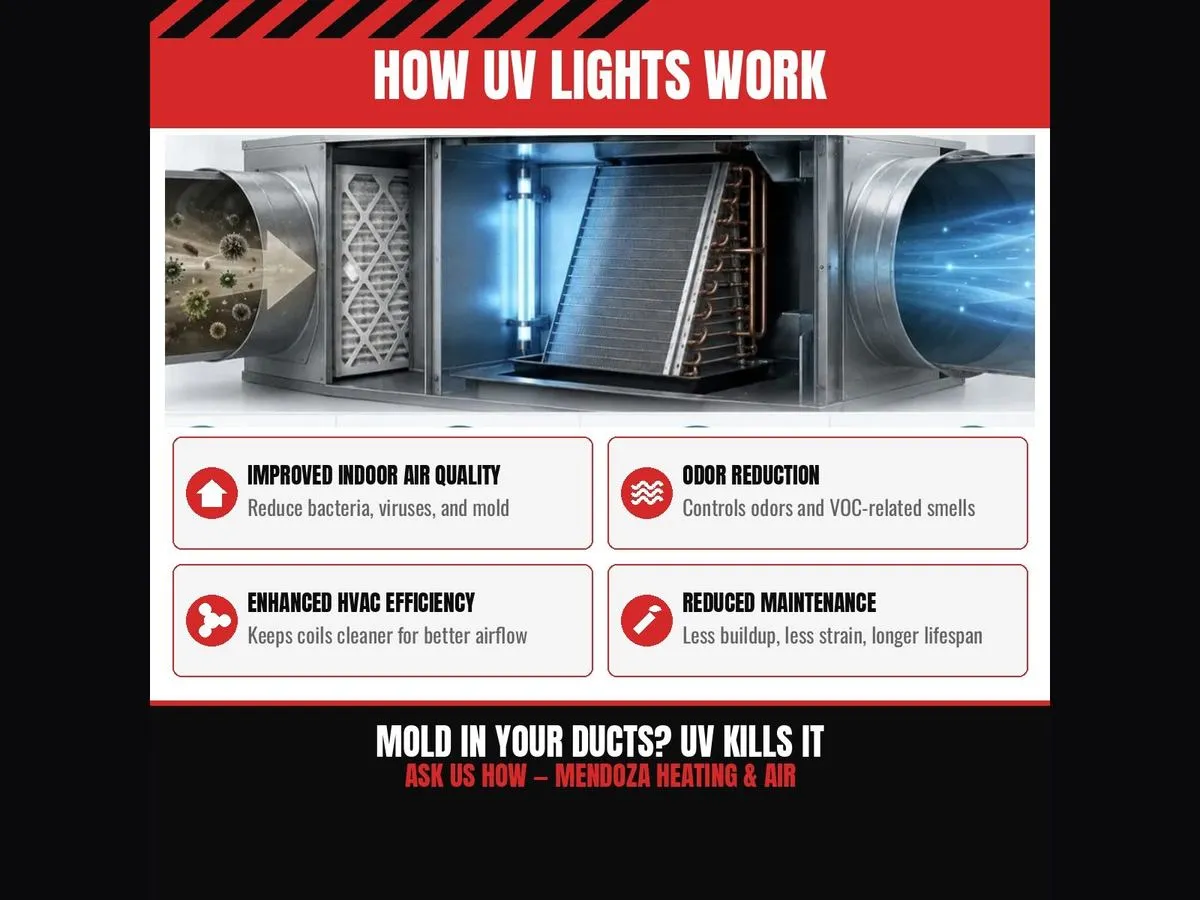
Open up an air handler in Tampa that's been running a few summers and you'll usually find the same thing: a coil with a biology project growing on it. Your evaporator coil is cold, dark, and wet — basically a luxury resort for mold and bacteria. Every time the system runs, air passes over that growth on its way into your house. A UV light installed inside the unit attacks exactly that problem: ultraviolet light breaks down mold, bacteria, and viruses on the coil and in the air stream, so the growth never gets started. That's the real job. Everything else people claim for it needs an asterisk.
What UV does — and doesn't — do
“I won’t sell you a UV light as a magic air purifier, because it isn’t one. What it is: the thing that stops your coil from growing a science project in Tampa humidity — and in this town, that’s not a small thing. We include one free with every new system we install. That tells you how much I believe in it.”
Why Tampa, specifically
UV lights make more sense here than in most of the country, and it comes down to moisture. Tampa systems pull gallons of water out of indoor air all summer, the coil stays wet for months straight, and wet + dark + warm-ish is mold's favorite address. In a dry climate, coil growth is a minor issue. Here it's a when, not an if — the only question is whether you clean it off twice a year or prevent it from growing in the first place.
Who should seriously consider one
Homes where someone has allergies or asthma and the system is a known trigger source. Houses with a recurring musty smell every cooling season. Anyone replacing a system — the light installs easiest and cheapest while the new air handler is open anyway (and with us, it's included free with a new installation). And honestly: anyone whose last coil cleaning photo looked like a horror movie. If your coil stays clean and your house smells fine, a UV light is a nice-to-have, not a need — we'll tell you that to your face.
Questions & Answers
Do UV lights really improve indoor air quality?
They help — with a specific job. A UV light inside your air handler sterilizes the coil and the air passing through it, which cuts mold and bacteria growth. It is not a filter: it won't trap dust or pollen. Think of it as keeping the system itself clean so it's not growing what it blows into your home.
Where does a UV light get installed?
Inside the air handler, aimed at the evaporator coil — that's the coil-sterilization style, and it's the most common in Tampa homes. Some systems place a light in the ductwork to treat air as it passes. Either way it sits sealed inside the equipment, out of sight.
How often does a UV bulb need replacing?
About every 12 to 24 months. Here's the catch: the bulb still glows long after its germ-killing output fades, so "the light's on" doesn't mean it's working. Bulb checks are part of a proper tune-up.
Do UV lights help with musty smells?
For the most common musty smell in Tampa homes — mold growing on a wet coil — yes, because UV stops the growth at the source. It won't remove odors from cooking, pets, or smoke; that's not its job.
Is UV light safe to have in my home's system?
Yes. The light is sealed inside the air handler where nobody looks at it or is exposed to it. You should never stare at a bare UV-C bulb during service — that's a technician-side rule, and it's why installation belongs to a pro.
Breathing easier?
Ask us about a UV light for your system — free with every new installation, honest advice either way.
Call (813) 770-2722 Ductwork & Air Quality