
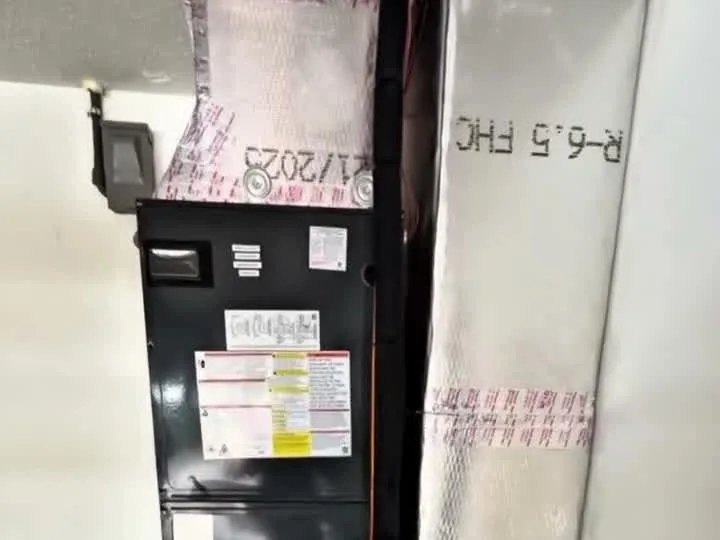
Everybody watches the big box outside. It’s the one you see, the one you hear kick on. But in Tampa, the half that usually gives out first is the one you almost never look at: the air handler, tucked in a closet, a garage corner, or an attic. It lives in water — every bit of humidity your system pulls out of the air runs through it. Sooner or later, that catches up with it.
What’s inside the box
An air handler is four things doing one job: an evaporator coil that actually cools your air, a blower that pushes it through your ducts, a drain pan and drain line that carry away the condensation, and the controls that run the show. When it’s working, you never think about it. When it isn’t, you find out fast — usually as water where water shouldn’t be, or a system that just stops.
The outdoor unit gets all the attention because it’s visible. The indoor unit does the wet work.
Why the indoor half takes the beating in Florida
Florida air is wet, and your air conditioner is a dehumidifier that happens to cool. All summer, gallon after gallon of water condenses on that indoor coil and drains away through the pan and the line. Day after day, year after year. The outdoor condenser is built to live in weather. The indoor unit lives in water — and water wins eventually.
- Drain pans rust. Most older pans are galvanized steel. They hold standing water every time the system runs, and in a hot garage or attic they never fully dry. Rust starts at the seams and corners, and a pinhole is all it takes to start dripping.
- Drain lines clog. Warm, dark, wet — algae and sludge love a condensate line. A clogged line backs water into the pan until the float switch trips and shuts the whole system down. That “AC just stopped” call is a drain call more often than people think.
- Coils corrode and foul. The evaporator coil sits in a damp airstream its whole life, collecting dust that gets past the filter. A dirty coil cools worse, freezes easier, and strains everything downstream.
- Blowers and motors wear. A blower pushing against a dirty filter and leaky ducts runs hot and long. Motors and capacitors don’t last forever, and attic heat doesn’t help.
None of this is a defect. It’s just what water and heat do over time. The difference between a pan that gets replaced and a ceiling that gets soaked is usually how early somebody looked.
The warnings — if you know where to look
- Water stains on the ceiling under the unit, or dampness around the closet or garage wall.
- A musty smell when the system runs — standing water and a dirty coil.
- The system shuts off out of nowhere, then comes back — the float switch doing its job because the pan is full.
- Rust on the cabinet or around the drain connection.
- Weak airflow, or ice on the lines — a coil that’s fouled or starved for air.
Any one of these is worth a look before it becomes a leak. Water damage costs more than every item on this list combined.
What the fix looks like — and when replacement wins
Small problems get small fixes: the drain line gets cleared and treated, the float switch gets tested, a rusted pan gets swapped. Catch a pan early and it’s a pan. Catch it late and it’s a pan, a coil, and drywall.
A coil that’s leaking or rotted usually means a new coil. A cabinet that’s rusted through, or a handler old enough that parts are gone, usually means a new air handler. And here’s the honest part: the indoor and outdoor halves are a matched set. Swapping one half of an old system can cost you efficiency and warranty coverage on the new half — sometimes the right move is the whole system, sometimes it isn’t. That’s exactly what the $5,000 rule is for — it keeps the repair-or-replace math honest. Read it before you approve a big repair. And if a new system is on the table, the SEER2 explainer is worth five minutes first.
Either way, the estimate is free, and the answer should be the same whether the job is big or small: what’s actually wrong, what it costs to fix, and what it costs to replace. Then you decide.
Keep it alive
The unglamorous stuff is what saves air handlers: change the filter on time, keep the drain line clear, and let somebody who knows what a rusted pan looks like see it once or twice a year. The $75 tune-up checks the drain, the pan, the coil, and the float switch — the four things that end most indoor units. It runs through November 30.
“Everybody stares at the big box outside. That one’s built for weather. The one inside lives in water — every gallon of humidity your system pulls out of the air runs through that drain pan. Pan rusts, drain clogs, float switch trips, and the call I get is ‘my AC just stopped.’ Most of the time, the trouble started inside. Check the pan before you blame the box outside.”
Questions & Answers
Why does my AC keep shutting off for no reason?
Most often, it’s the float switch — the safety that shuts the system down when the drain pan fills. A clogged drain line backs water into the pan, the switch trips, and the system stops before it floods anything. Clearing and treating the drain usually brings it right back. If it keeps happening, the line or the pan needs a closer look.
Can you replace just the drain pan?
Yes — if the rust is caught before it spreads to the coil or the cabinet. A pan swap is a small job. A pan that’s been leaking a while usually isn’t alone, which is why the estimate is free: we look first, then tell you whether it’s a pan or something bigger.
Should I replace the indoor and outdoor units together?
Usually, yes — they’re a matched set, and mixing an old half with a new one can cost efficiency and warranty coverage. But “usually” isn’t “always.” It depends on the age and condition of what’s there. That’s a free-estimate conversation, not a phone guess.
How long does an air handler last in Florida?
Florida systems run 10 to 15 years, and the indoor half is often the first to go inside that window — it lives in water and heat full-time. Twice-yearly maintenance is what stretches it; well-kept systems reach 13 to 16 years. The full picture is in our lifespan post.
AC Stopped Out of Nowhere? Free Same-Day Estimates.
We’ll find what’s wrong inside — drain, pan, coil, or the whole handler — and give you the repair number and the replacement number. Call (813) 770-2722. $500 off a new system, with a free UV light, is running now.
Call (813) 770-2722 AC Repair AC Tune-Up Maintenance Plans